


Leadership training is not a “nice-to-have”. It is a strategic investment. But with training budgets under scrutiny and stakeholders demanding measurable results, HR and L&D professionals are under pressure to prove that leadership development delivers real business impact. The key? A focused, realistic approach to measuring return on investment (ROI).
This blog outlines how to measure the ROI of leadership training using practical metrics, simple frameworks, and best practices that resonate with executives.
Why Measuring ROI Matters in Leadership Development
According to a recent LinkedIn Learning report, 60% of HR leaders list leadership development as a top priority, yet fewer than 30% feel confident in measuring its impact. That disconnect undermines support and funding for future training programs.
When you measure ROI well, you:
• Justify training budgets
• Improve program design through feedback
• Demonstrate alignment with business goals
• Build credibility with senior stakeholders
Measuring ROI isn’t about tracking every dollar. It’s about showing that leadership training drives outcomes that matter to your organization.
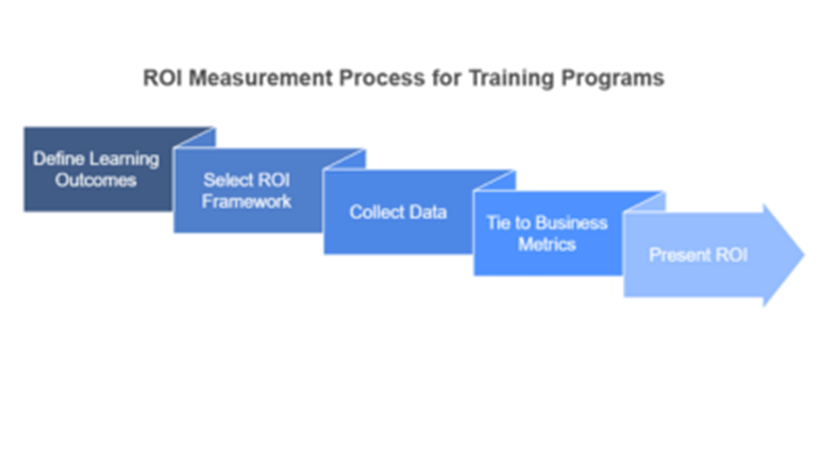
Step 1: Define Clear Learning Outcomes and Business Objectives
You can’t measure what you haven’t defined. Before launching a program, align training goals with organizational priorities.
Some examples:
• Improve employee retention through better frontline management
• Increase internal promotion rates within leadership roles
• Reduce time-to-productivity for new managers
• Boost team engagement scores
Set both qualitative goals (e.g., “leaders feel more confident coaching teams”) and quantitative targets (e.g., “reduce voluntary turnover by 15%”).

Step 2: Use the Right ROI Measurement Framework
A popular model for measuring training ROI is Kirkpatrick’s Four Levels:
1. Reaction – How did participants feel about the training?
2. Learning – What knowledge or skills did they gain?
3. Behavior – Are they applying what they learned on the job?
4. Results – What organizational changes occurred as a result?
Layer in ROI calculations by assigning financial value to measurable outcomes. For example, if better leadership reduces turnover, estimate the cost savings of lower attrition.
Step 3: Collect Data Before, During, and After Training
To connect the dots, build a data trail:
• Pre-training assessments to establish baselines (360° feedback, engagement scores, performance ratings)
• In-program surveys and assignments to monitor engagement and application
• Post-program results to track behavioral changes and business KPIs
Don’t rely solely on self-reporting! It is better to pair participant feedback with manager evaluations, team performance data, and HR analytics.
Step 4: Tie Training Back to Business Metrics
Here’s where many programs fall short. Link leadership development to key performance indicators:
KPI |
How Leadership Training Influences It |
|---|---|
Employee Retention |
Better communication and support from trained managers reduce turnover |
Internal Promotion Rate |
Leaders groomed through development are more likely to be promoted internally |
Productivity |
Teams led by trained managers report clearer goals and faster execution |
Engagement Scores |
Leadership behaviors shape culture, inclusion, and motivation |
Even if you can’t assign precise dollar values, highlighting performance improvements with supporting data builds a strong case.
Step 5: Present ROI to Stakeholders
Executives care about results. Package insights in ways they can quickly absorb:
• Visual dashboards of participation and outcomes
• Case studies highlighting leader transformations
• Testimonials from managers and direct reports
“After our department leads completed the Delegation and Communication modules, we saw a 20% increase in on-time project delivery.”
– Sample Testimonial to Include
Real-World Tip: Use Micro-Learning to Boost Measurable Impact
Leadership Edge Live offers live, 30-minute weekly training with built-in bridgework assignments and coaching follow-ups. These small actions lead to measurable behavior change, which directly supports ROI tracking.
Want your leadership training to drive visible results? Start with practical programs designed for real-world transfer of learning.
Explore the full list of live, skill-based courses in our Course Catalog.
Final Thoughts
You don’t need a PhD in analytics to prove leadership training works. By aligning goals with business priorities, collecting the right data, and using simple frameworks, you can make a strong ROI case.
Effective leadership transforms teams and business outcomes. When you measure what matters, you earn the right to scale those results.
Frequently Asked Questions
Q1: What is the ROI of leadership training?
ROI refers to the measurable return on the investment in leadership training, such as improved employee retention, increased productivity, and promotion readiness.
Q2: How can I track the effectiveness of a leadership development program?
Use pre- and post-program assessments, behavior observations, manager feedback, and performance metrics to evaluate change over time.
Q3: What tools can help measure training ROI?
Common tools include 360-degree assessments, employee engagement surveys, HR dashboards, and feedback platforms that capture both qualitative and quantitative results.
Ready to design leadership training that delivers results?
Visit our leadership training platform to find outcome-driven programs tailored to your business goals.


